JEV vs LLM
What TypeSafe's Decision Model Means for Your Business Everyone's about to compare a new AI model to ChatGPT. That comparison misses the point. The model is called Jev, from a lab called TypeSafe AI. It doesn't chat. It doesn't write. It answers one question what should happen next for less than a cent, in under a second. That's not a smarter chatbot. It's a different tool for a different job, and most Australian SMBs are already trying to do that job with the wrong tool.
Two jobs, one confused industry
AI has mostly done one job: write text for a person to read. Ask it something, it writes a paragraph, you read it and decide what happens next.
Most decisions running through an SMB never reach a person first. Route this job to the right technician. Flag this invoice as unusual. Decide if a quote needs a manager's sign-off before it goes out.
Automate those with a normal LLM and you're asking a writer to make a decision, then parsing its sentence back into a yes or no your software can act on. That's slow, and it's an extra place things can break.
Jev skips the writing. Send it the situation and a typed question should this quote go to Technician A or B? and it returns the answer directly, with a confidence score. No essay. No parsing.
Here's the split, side by side:
Traditional LLM | Jev (System One) | |
|---|---|---|
Output | Free-form text | A typed decision + confidence score |
How it answers | Generates word by word | Answers in one parallel pass |
Speed (TypeSafe's own benchmark) | Baseline | Up to ~200x faster |
Cost (TypeSafe's own benchmark) | Baseline | Up to ~400x cheaper |
Writes prose or code? | Yes | No |
Best for | Explaining, drafting, conversation | Routing, flagging, approvals, agent decisions |
Figures per TypeSafe AI, September 2026.
How it actually works
A normal LLM writes one word at a time. Each word depends on every word before it, so the model reruns its reasoning for every single word until the sentence ends. That's why a long reply takes several seconds it's writing, not thinking once.
Jev skips that loop. TypeSafe calls it a System One model, after the psychologist Daniel Kahneman's split between fast, intuitive judgment and slow, deliberate reasoning. You send it a state the situation, as text or data plus one or more typed questions, each with its own answer shape: yes/no, a score, a pick from a list. It answers all of them at once, in parallel.
Because it can only ever answer inside the shape you gave it, TypeSafe reports zero schema violations across its own benchmark the model can't return something malformed. That's narrower than "always correct". The output is never broken. Whether the decision itself is right is still something you calibrate against your own data.
Picture the two paths side by side:
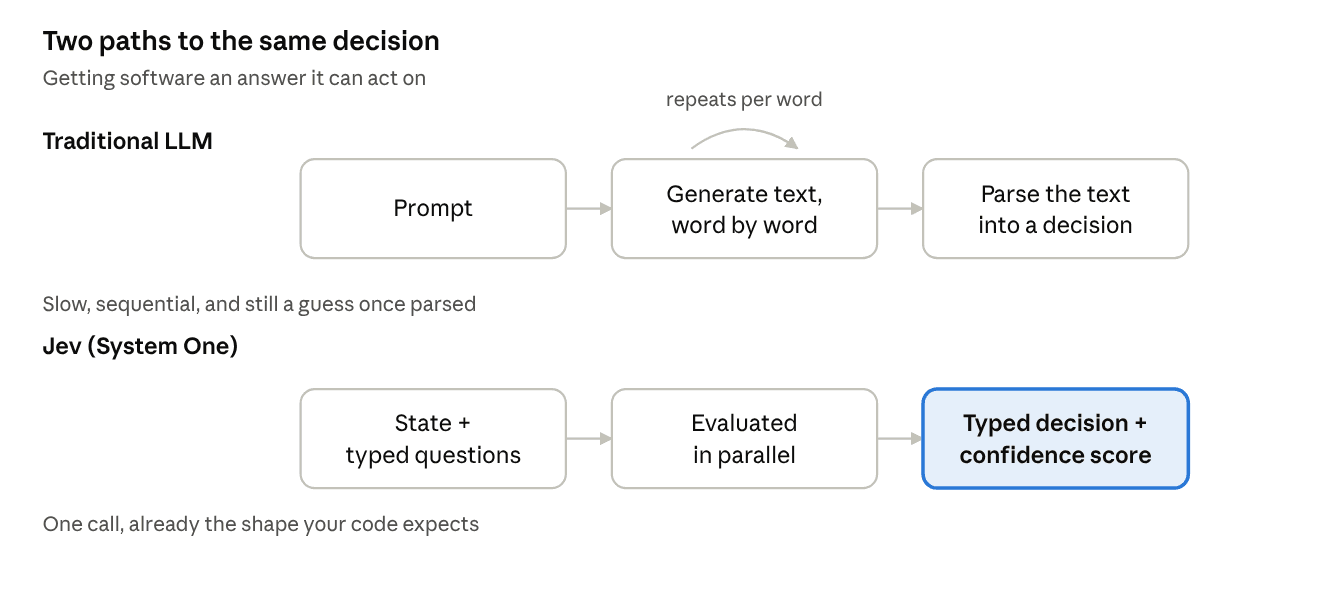
two paths to a decision · LLM vs Jev
The bottom row is the same decision, minus the guesswork.
Where this shows up in your business
Three places this could slot into work we already do for clients not as a rebuild, as a layer in front of what's already running.
Field services. A trade business quoting jobs through Codify still needs a human to catch the unusual ones an odd site condition, a price 30% off the norm. Today that flag is a hard-coded rule, or another LLM call writing a paragraph that then gets parsed. A decision layer could answer one typed question is this quote inside normal range, and how confident the moment the quote is drafted. Inside the range, it goes straight to the client. Outside it, it lands on the estimator's desk.
Aged care. Not every shift note or incident report needs a chatbot summary most are routine. What helps is fast triage: does this note mention a fall, a medication error, or a complaint, and how urgent is it. That check can run on every note the second it's logged, and only the ones that clear a threshold go to a person, or to a generative model to write up properly.
Professional services. Document intake contracts, engagement letters, compliance forms involves a repeated judgment call: which one needs partner review, which a junior can handle, which is missing a required clause. That's a structured decision made over and over, not a writing task exactly the kind of call this category of model is built to make cheaply, at volume, flagging only the genuinely uncertain ones.
The honest limits
Jev doesn't write anything a client will read. No emails, no reports, no quotes in prose, no code. TypeSafe says so directly: use a generative model for the written update, with the evidence and any approved decisions fed in separately.
It doesn't replace judgment either just the parsing step around it. A model that can't be malformed can still be confidently wrong. Whether "90% confident" actually means right 90% of the time is something you check against your own data before any threshold acts without a person watching.
And it's new. TypeSafe launched Jev in early access in mid-September 2026, built by Diego Almeida, a co-creator of the RLHF technique behind ChatGPT. System One models are a new category, not yet a proven one.
Bottom line
Most businesses don't have an AI-decision problem. They have an "everything routes through a person because nothing else can be trusted to decide" problem.
Cheap, typed, calibrated decisions change that math not by replacing the people making judgment calls, but by clearing the routine ones off their desk so the judgment calls are the only ones left.
The model is new. The problem it points at a business full of small, repeated decisions still done by hand isn't. If you can name three of those in your business right now, that's the actual starting point, not the model.
Start there. Book an AI Discovery Workshop and we'll map where a layer like this would save the most hours, before you touch a single API.