RAG Evaluation Framework for Mid-Market Teams: A Practical Implementation Guide
Learn how to evaluate RAG systems without dedicated ML teams. Practical metrics, debugging workflows, and governance frameworks for Australian and New Zealand mid-market organisations.
Why Most AI Prototypes Fail in Production
Most AI prototypes fail in production because teams skip the unsexy work of measurement. You can't deploy a retrieval-augmented generation system without knowing whether it retrieves the right documents or hallucinates answers.
Mid-market teams face a specific challenge: you need production-grade evaluation without the luxury of dedicated ML engineers or custom tooling budgets. You're probably wearing multiple hats—IT operations, security, vendor management, and now AI implementation. Custom evaluation infrastructure isn't realistic when you're managing everything else.
This guide walks through practical RAG evaluation metrics, debugging workflows, and governance frameworks designed for small IT teams working within real-world constraints. If you're implementing RAG systems in Australian or New Zealand organisations, you'll also find specific guidance on data residency requirements and Microsoft 365 integration.
Understanding RAG System Performance
What Makes RAG Different from Traditional Search
Traditional keyword search returns documents containing your search terms. RAG systems combine semantic understanding with text generation, which creates a fundamentally different failure mode.
When keyword search fails, you get zero results or obviously irrelevant documents. Users know immediately that something went wrong.
When RAG systems fail, they produce plausible-sounding answers that are completely wrong. This is far more dangerous because users may trust incorrect information.
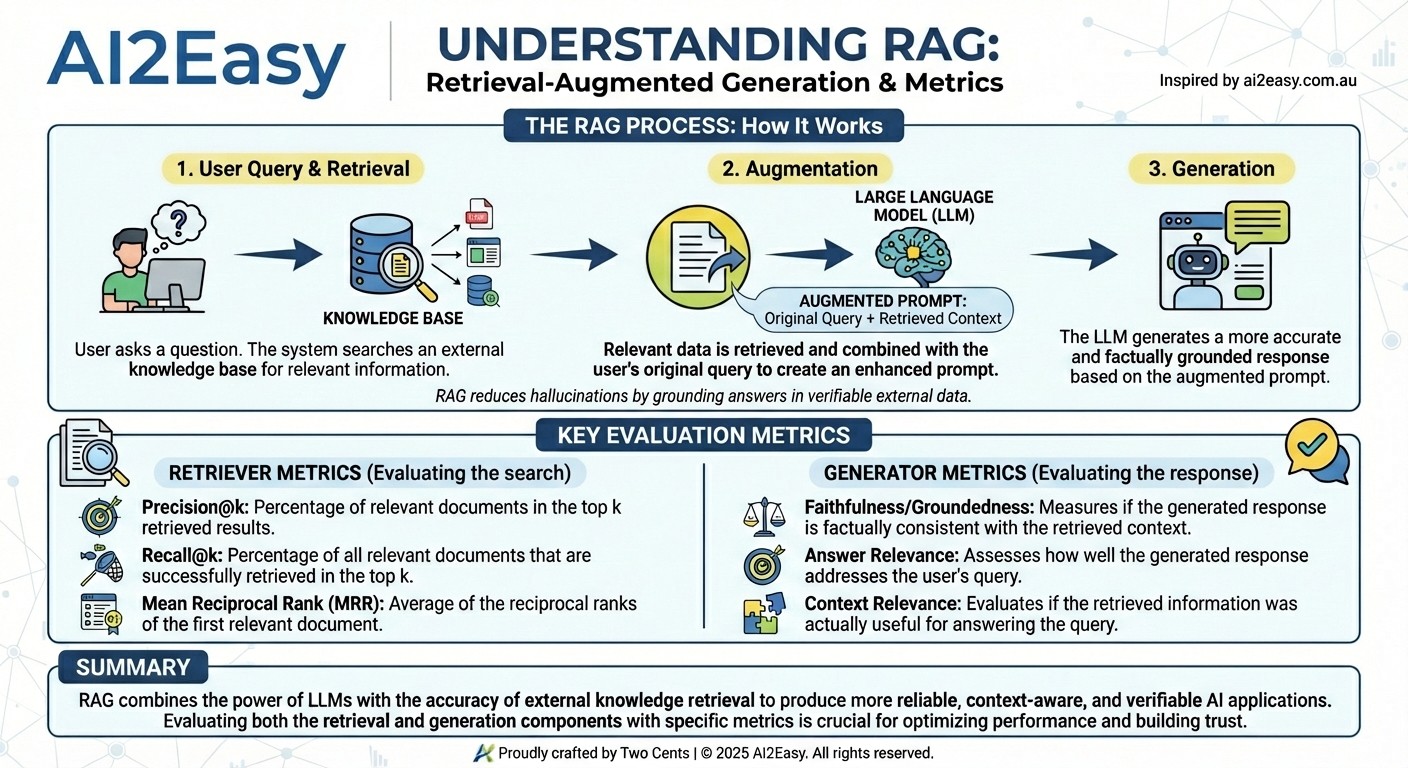
The semantic retrieval component finds contextually similar content even when exact keywords don't match. The generation component synthesises an answer from retrieved chunks. This two-stage architecture means you can:
Retrieve perfect context but still generate garbage (generation failure)
Retrieve irrelevant documents but produce a decent answer through model knowledge (retrieval failure masked by the model)
Understanding this architecture is essential for effective evaluation. You need to measure both stages independently to diagnose problems accurately.
The Systems Thinking Perspective
From a systems thinking perspective, RAG evaluation is about understanding feedback loops and identifying leverage points.
The core feedback loop: Users ask questions → System retrieves documents → Model generates answers → Users assess quality → System improves (or doesn't).
Without measurement, this loop is broken. You have no signal about what's working or failing. Users may stop trusting the system without telling you why. Problems compound silently.
The leverage point: Systematic evaluation creates visibility into system behaviour. This visibility enables targeted improvements rather than guesswork. Small investments in evaluation infrastructure yield disproportionate returns in system reliability.
Core RAG Evaluation Metrics
Retrieval Metrics: Did We Find the Right Documents?
Recall@k: Measuring Coverage
Recall@k measures what percentage of all relevant chunks appear in your top-k retrieved results.
Example: If you have five relevant documents in your knowledge base and three appear in the top 10 results, your Recall@10 is 0.60 (60%).
What it tells you: Whether your retrieval system has access to the information needed to answer questions correctly.
What low recall indicates: Fundamental retrieval problems—wrong embedding model, poor chunking strategy, or inadequate indexing. You can't generate good answers if the right context never reaches your model.
Target: Recall@10 > 0.70 for production systems.
Mean Reciprocal Rank (MRR): First-Result Quality
MRR calculates the average of reciprocal ranks across queries. If the first relevant chunk appears at position 3, the reciprocal rank is 1/3 (0.33).
What it tells you: Whether relevant results appear near the top of your results.
Why it matters: Many RAG systems use only the top few results for generation. If relevant context consistently ranks fifth or lower, your answers will suffer even with decent overall recall.
Interpretation:
MRR of 0.85 = relevant results typically appear near the top
MRR of 0.40 = your ranking needs work
Precision@k: Filtering Noise
Precision@k measures what percentage of your top-k retrieved results are actually relevant.
Example: If you retrieve 10 chunks and only 4 are relevant, your Precision@10 is 0.40 (40%).
The precision-recall tradeoff: Retrieving more results increases recall but typically decreases precision by including more noise. You need both metrics to balance accuracy against coverage.
Interpretation:
High precision with low recall = being too conservative
High recall with low precision = flooding the context window with irrelevant information
Generation Metrics: Did We Produce Good Answers?
Groundedness (Faithfulness): Preventing Hallucinations
Groundedness evaluates whether generated output is factually consistent with retrieved documents. Every claim in the answer should trace back to specific passages in the retrieved context.
This is the opposite of hallucination. A grounded answer only states what the source documents support. An ungrounded answer invents facts or speculates beyond the evidence.
The RAG triad (from TruLens) consists of:
Context relevance (did we retrieve relevant documents?)
Groundedness (did we stay faithful to those documents?)
Answer relevance (did we actually answer the question?)
Satisfactory scores on all three give you confidence that your system is free from hallucination.
Target: Groundedness > 0.85 for production systems.
Citation Accuracy: Source Attribution
Industry studies report citation accuracy rates of only about 74% for popular generative search engines. This means roughly one in four citations either points to the wrong source or misrepresents what the source actually says.
Two dimensions of citation quality:
Citation precision: Do citations match actual source content?
Citation coverage: Do all claims have supporting citations?
Precise citations linking claims to exact paragraphs separate professional applications from chatbot demos. For regulated industries or legal use cases, citation accuracy becomes a compliance requirement.
Target: Citation precision > 0.75 for production systems.
Answer Relevance: User Intent Matching
Answer relevance assesses whether the generated response directly addresses the original query. A response can be perfectly grounded in retrieved context but still fail to answer the actual question.
Example failure: User asks "How do I reset my password?" System retrieves password policy documents and generates an accurate summary of password requirements—but never explains the reset process.
This metric catches cases where the system retrieves tangentially related documents and generates technically accurate but unhelpful responses.
Struggling to evaluate your RAG implementation?
We help mid-market teams implement RAG systems with proper evaluation frameworks from the start. Our discovery process identifies the right metrics for your specific use case and builds evaluation into the deployment from day one.
Building Your Evaluation Workflow
Stage 1: Pre-Deployment Testing
Create a golden dataset with known questions, expected sources, and ideal answers. Start with 50-100 domain-specific questions that represent actual user needs.
For each question, document:
The question itself
Which sources should be retrieved
What a good answer looks like
Any edge cases or potential failure modes
Why this matters: This dataset becomes your repeatable baseline for measuring changes. When you adjust chunking strategies or switch embedding models, you can quantify whether performance improved or degraded. Without this baseline, you're flying blind.
Practical tip: Involve subject matter experts in creating the golden dataset. They know what questions users actually ask and what constitutes a helpful answer. Technical teams often create evaluation sets that don't reflect real-world usage.
Stage 2: Metric Collection Setup
RAGAS offers faithfulness, relevance, and semantic similarity scoring that integrates with LlamaIndex and existing RAG pipelines. The framework automates scoring across your golden dataset without manual calculation.
LlamaIndex provides MRR, hit rate, and precision calculations for evaluating retrieval quality. These metrics help you assess the impact of changing embedding models or adjusting retrieval parameters.
Implementation approach:
Set up automated scoring against your golden dataset
Run evaluation whenever you make system changes
Track metrics over time in a simple spreadsheet or dashboard
You don't need sophisticated MLOps infrastructure. Consistency matters more than tooling sophistication.
Stage 3: Human-in-the-Loop Validation
Automated metrics need validation from subject matter experts. Schedule monthly reviews where SMEs evaluate 20-30 representative queries.
What human reviewers catch that automation misses:
Citations that technically support claims but feel misleading
Answers that are accurate but tone-deaf to user context
Subtle quality issues that don't show up in metrics
Domain-specific nuances that generic evaluation can't assess
The "vibe check" is necessary. You can't automate everything. Regular human review keeps your evaluation grounded in real user needs rather than abstract metrics.
Stage 4: Continuous Monitoring
Track drift in retrieval quality and answer accuracy post-deployment. Systems degrade over time as knowledge bases change and user needs evolve.
Set alert thresholds:
Groundedness below 0.85
Recall dropping more than 10% from baseline
Sudden spikes in low-confidence answers
These alerts catch degradation before users complain.
Monitor source utilisation: Track which sources are being retrieved most frequently. If certain documents dominate results inappropriately, it signals indexing or ranking problems. If important sources never get retrieved, that's a coverage gap.
Maintain audit logs showing retrieved sources and data flow. These logs support both debugging and compliance requirements. When answers go wrong, you need to trace exactly what the system retrieved and why.
RAG Debugging Checklist
Isolating Retrieval vs Generation Failures
The diagnostic principle: Use retrieval metrics to determine whether you have a retrieval problem or a generation problem. This prevents wasting time optimising the wrong component.
Symptom | Likely Cause | Focus Area |
|---|---|---|
Low recall | Retrieval issue | Indexing, embeddings, chunking |
High recall + high hallucination | Generation issue | Prompts, context presentation |
High precision + low recall | Too conservative | Similarity thresholds, top-k settings |
Low precision + high recall | Too permissive | Reranking, filtering |
First step: Check a few failing examples manually before diving into systematic fixes. Sometimes patterns emerge immediately—all failures involve tables, or specific document types never retrieve correctly. These quick checks save hours of debugging.
Common Failure Modes
Ingestion problems:
Missing documents (not all expected content made it into the index)
Malformed chunks (encoding issues, corrupted text)
Incorrect metadata (wrong tags, missing attributes)
Embedding issues:
Embedding drift (new documents use different model than existing content)
Domain mismatch (general-purpose embeddings don't understand your vocabulary)
Inconsistent representations (breaks retrieval consistency)
Retrieval configuration:
Similarity threshold too high (missing relevant results)
Top-k too low (not enough context for generation)
Reranker misconfiguration (shuffling relevant results below irrelevant ones)
Generation problems:
Context overload (too many chunks overwhelming the model)
Poor prompt template (not emphasising groundedness)
Stale context (outdated information in retrieved documents)
Systematic Debug Workflow
Test ingestion consistency - Verify all expected documents are indexed
Check chunk boundaries - Ensure splits make semantic sense
Validate metadata integrity - Confirm filtering works correctly
Verify embedding quality - Check that similar documents cluster together
Review retrieval scoring - Test similarity thresholds and ranking logic
Examine generation prompts - Ensure groundedness is emphasised
When to Escalate vs Iterate
Escalate if:
Your embedding model fundamentally fails on your domain vocabulary
Technical documents retrieve poorly due to specialised terminology
Core architecture decisions need revisiting
Iterate on:
Prompts and prompt templates (quick, reversible changes)
Chunk size and overlap settings
Retrieval parameters (top-k, similarity thresholds)
Reranking configuration
Document what you try so you don't repeat failed experiments.
Evaluating Knowledge Agent Performance
Evaluation approach:
Sample 50 documents across different types
Compare automated tags to SME-assigned classifications
Calculate precision and recall for the tagging system
Measure impact on RAG groundedness scores
Key question: Does improved metadata actually increase groundedness scores? Measure before and after implementing Knowledge Agent to quantify the impact.
Multi-Source Considerations
Many organisations store information in both SharePoint and other systems (Confluence, file shares, legacy systems). Your evaluation must cover all sources.
Test questions:
Does content from different sources retrieve with similar quality?
Are there format-specific issues affecting certain sources?
Do metadata structures vary in ways that affect retrieval?
Adjust chunking strategies per source type if needed.
Need help integrating RAG with your existing environment?
We specialise in connecting AI systems to the tools your team already uses. Our integration approach ensures RAG evaluation covers all your knowledge sources—SharePoint, Teams, email, and beyond.
Australian Data Residency Requirements
Compliance Fundamentals
Australian data residency AI means all AI processing occurs exclusively within Australian data centres and is subject only to Australian law. This includes:
Customer inputs
AI responses
Voice recordings
Knowledge base queries
Evaluation data
Sector-specific requirements:
Health data: Must never be processed, stored, transmitted, or managed outside Australia
Financial data: APRA regulations impose restrictions on cross-border data transfers
Legal data: Professional privilege requirements may mandate domestic processing
The Australian Privacy Act governs personal information treatment. While there are no broad data residency requirements under Australian Privacy Principles, sector-specific restrictions apply.
Evaluation Setup for Sovereign Systems
Verify your entire stack runs domestically:
Embeddings generation
Vector storage
LLM inference
Evaluation pipelines
Logging and monitoring
Backup systems
Critical check: If you're using external evaluation services or LLM judges, ensure they process data domestically. Evaluation that sends data offshore defeats the purpose of sovereign deployment.
End-to-end testing: Test data flow to confirm no processing occurs outside Australia. A single component processing data internationally can compromise your entire compliance posture.
Documentation Requirements
Maintain audit logs showing:
Retrieved sources for each query
Data flow paths
Processing locations
Access records
These logs prove compliance for regulated content and support investigations if issues arise.
Schedule quarterly reviews of data processing locations. Compliance isn't a one-time setup—it requires continuous verification. Update documentation as systems change.
Governance Framework for Mid-Market Teams
Establishing Baseline Quality Standards
Recommended minimum thresholds before production deployment:
Metric | Minimum Threshold | Notes |
|---|---|---|
Recall@10 | > 0.70 | Ensures adequate coverage |
Groundedness | > 0.85 | Prevents significant hallucination |
Citation precision | > 0.75 | Supports trust and verification |
Adjust based on risk tolerance:
Customer-facing applications need higher standards than internal knowledge bases
Healthcare or legal applications require near-perfect groundedness
Internal tools for technical teams can tolerate lower thresholds initially
Document your rationale. This helps future teams understand the tradeoffs and adjust standards as the system matures.
Creating Evaluation Cadence
Timeframe | Activity |
|---|---|
Weekly (first 90 days) | Spot-checks on sample queries |
Monthly | Full metric review against golden dataset |
Quarterly | Golden dataset refresh, threshold review |
Annually | Comprehensive governance review |
Establish a feedback loop from users to evaluation. When users report bad answers, add those queries to your golden dataset. This ensures evaluation stays aligned with real-world usage patterns.
Stakeholder Reporting
Report metrics in business terms:
Instead of: "MRR increased from 0.72 to 0.81"
Say: "Relevant answers now appear in the top 3 results 81% of the time, up from 72%"
Include in executive reports:
Accuracy percentages
Failure rates and trends
Citation coverage
User feedback themes
Improvement actions taken
Include qualitative feedback alongside quantitative metrics. User quotes about helpful answers or frustrating failures make reports more actionable than numbers alone.
Implementation Roadmap
Week 1-2: Baseline Assessment
Activities:
Collect 50-100 representative questions from stakeholders
Document expected answers and relevant sources
Select 3-4 core metrics (Recall@10, groundedness, answer relevance)
Run initial measurements to establish baseline
Create tracking spreadsheet or dashboard
Deliverable: Baseline performance documentation
Week 3-4: Metric Automation
Activities:
Implement RAGAS or equivalent framework
Configure automated scoring against golden dataset
Set up monitoring dashboards
Configure alerting for quality degradation
Test automation pipeline against manual assessment
Deliverable: Automated evaluation pipeline
Month 2-3: Refinement Cycle
Activities:
Iterate on chunking, embeddings, and prompts based on metrics
Make one change at a time and measure impact
Validate improvements with human reviewers
Document what works and what doesn't
Expand golden dataset based on observed failures
Deliverable: Optimised system with documented improvements
Ongoing: Monitoring and Governance
Activities:
Monthly metric reviews
Quarterly golden dataset updates
Track emerging failure modes
Refine thresholds based on experience
Maintain compliance documentation
Deliverable: Continuous improvement process
Lightweight Tools and Resources
RAGAS for Automated Evaluation
RAGAS offers faithfulness, relevance, and semantic similarity scoring with integrations for LlamaIndex and common RAG pipelines.
Key features:
Automated scoring without manual calculation
Custom metrics with simple decorators
Synthetic test dataset generation
Open-source and actively maintained
Best for: Teams wanting comprehensive generation-focused evaluation without building custom infrastructure.
LlamaIndex Retrieval Metrics
LlamaIndex provides MRR, hit rate, and precision calculations for retrieval evaluation.
Key features:
Direct integration with LlamaIndex pipelines
Retrieval-focused metrics complementing RAGAS
A/B testing support for configuration changes
Best for: Teams already using LlamaIndex who want to add evaluation without restructuring.
Building Custom Evaluation Sets
Start small: 50-100 domain-specific questions provide a useful starting point. Expand based on actual user queries and failure patterns.
Include diverse query types:
Factual questions ("What is our policy on X?")
Comparison requests ("How does A differ from B?")
Troubleshooting scenarios ("Why isn't X working?")
Edge cases (unusual terminology, ambiguous queries)
Document thoroughly: For each query, record expected answers and relevant sources. Update as your knowledge base evolves.
Ready to implement RAG with proper evaluation from the start?
We help Australian and New Zealand organisations deploy RAG systems that work reliably in production. Our approach builds evaluation into the implementation from day one—not as an afterthought.
Our AI Discovery Workshop identifies your specific use cases, data residency requirements, and quality thresholds before we write any code.
Investment: $2,000-$5,000 with full money-back guarantee
Summary
Systematic evaluation transforms RAG from an interesting prototype into a production-ready system. Mid-market teams can deploy confidently by focusing on core metrics, lightweight tools, and repeatable processes rather than building custom infrastructure.
Key principles:
Separate retrieval from generation evaluation - Different problems require different solutions
Start with a golden dataset - You can't improve what you don't measure
Automate where possible, validate with humans - Both are necessary
Monitor continuously - Systems degrade over time
Document everything - Future you will thank present you
The framework outlined here works within typical mid-market constraints—no dedicated ML teams, limited budgets, and competing priorities. You don't need perfect evaluation to deploy successfully. You need good-enough measurement that catches major problems and guides incremental improvement.
RAG evaluation isn't a one-time gate before deployment. It's an ongoing practice that builds operational trust and enables continuous refinement. The teams that succeed treat evaluation as a core capability rather than a compliance checkbox.
AI2Easy helps Australian and New Zealand organisations implement AI systems that work reliably in production. Our discovery-first approach ensures we understand your specific requirements—including evaluation criteria and compliance needs—before recommending solutions.